





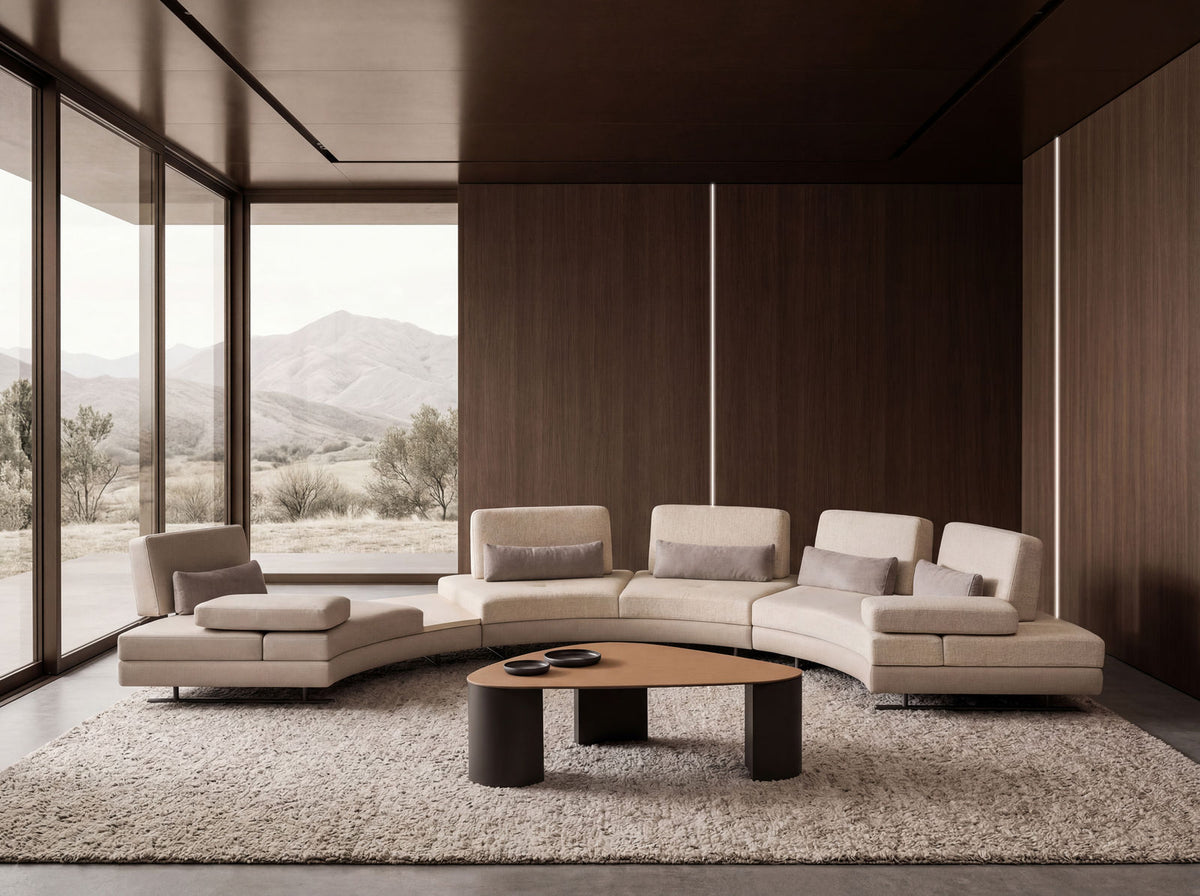
Sectional and modular get used interchangeably, including by people selling sofas. They describe different things, and buying the wrong one is how people end up with a sofa that fits the room they had rather than the room they have.
Sectional describes the shape. Modular describes whether the pieces come apart. A sofa can be both, which is why the labels alone will not tell you how much flexibility you are actually getting.
Sectional vs Modular Sofas: What’s the Difference?
Modular Sofas
Design. Separate upholstered units, armless seats, corners, chaises and ottomans, each finished on all sides so no face has to hide against a wall.

Flexibility and stability. The layout is yours to set and reset. The trade is that stability depends on how the units connect to each other, which is the most common complaint in the category and the thing worth asking about before you buy.
Delivery and aesthetics. Units ship in smaller boxes and clear tight hallways, doorways and stairwells one at a time. The finished piece reads as separate elements, with visible seams between them.
Best for. Renters and frequent movers, growing households, awkward rooms, and any layout that is not settled.
Sectional Sofas
Design. A fixed multi-seat unit, usually an L or a U, with the orientation chosen at purchase including which side the chaise sits on.

Flexibility and stability. The shape is decided for you, and in exchange nothing shifts. There is no connection to loosen, no piece drifting out of alignment on a hard floor, no gap opening under daily use.
Delivery and aesthetics. It arrives as a small number of very large pieces, so the route in matters. The payoff is a continuous, unbroken line that a run of separate units cannot match.
Best for. Large settled rooms, a fixed focal point, and anyone who wants one clean silhouette rather than a sofa assembled from parts. In smaller rooms the same logic points to a fixed sofa or loveseat instead.
|
Sectional |
Modular |
|
|---|---|---|
|
Design |
Fixed multi-seat unit, facing chosen at purchase |
Interchangeable units finished on all sides |
|
Flexibility |
Layout is set |
Reconfigured, split or expanded |
|
Stability |
Stays firmly in place |
Depends on how the units connect |
|
Delivery |
Fewer, larger pieces |
Smaller boxes through tight spaces |
|
Aesthetics |
Continuous line |
Visible seams between units |
|
Best for |
Settled rooms, fixed layouts |
Movers, changing layouts |
Read that in both directions. Stability and an unbroken line are real advantages, and if your room is settled they may be the ones that matter.
How Much Flexibility Are You Actually Buying?
Because the two words describe different properties, most sofas sit somewhere between the extremes rather than at one of them.
Fixed sectional. One engineered shape. The pieces join and stay joined.
Semi-modular sectional. The pieces detach, but the arrangement is largely predetermined. A chaise that can move from one end to the other and nothing beyond that is the common case.
Fully modular. Independent units that form genuinely different layouts and can be added to later.
Two questions place any sofa on that scale, and neither needs a spec sheet. How many different layouts do these pieces actually make? And can one person detach a single unit and move it without lifting the one next to it?
Ask those in a showroom and the answers come quickly. A product page that cannot answer them has told you where the sofa sits.
Can You Rearrange a Sectional Sofa?
Technically yes. Many fixed sectionals are joined with clips, hooks or brackets rather than permanent fixings, so the pieces can be separated to get them through a door or into a van.
Practically, no. The units are heavy, the configuration was engineered as a whole with weight distribution planned around that arrangement, and reconfiguring is not what the warranty is written to cover. On LAZZONI pieces that coverage is a lifetime warranty on the frame and a 6-year limited warranty on materials, mechanisms and upholstery, excluding normal wear and tear.
A sectional can come apart. What it will not do is become a different sofa.
Which Holds Its Value Better?
There is no reliable published data comparing resale performance between sectional and modular sofas. Figures circulate, but the ones we could trace lead back to marketing material rather than published research, with no stated methodology, and the claims derived from them contradict each other.
The structural argument is straightforward. A modular system can be sold in parts or adapted to a different room. A fixed sectional is an all-or-nothing sale that has to suit one buyer’s particular layout. That is reasoning from how the two are built, not a measured finding.
How to Choose Between Them
The choice is not really about taste. Both categories cover every style, and both come well made and badly made. It is about permanence.
Choose a sectional when the room is large and settled, the focal point is fixed, and you want one continuous line. The flexibility you would pay for in a modular system is flexibility you will never use.
Choose modular when the layout is unsettled, a move is likely, the room serves more than one purpose, or the space is awkward enough that you may want to try the furniture two or three ways.
The question that decides it: how confident are you that this room, in this house, will be holding this sofa in five years?
It is worth saying that the question is not academic. People do come back to a LAZZONI showroom a decade after buying, moving house or adding a room, wanting to build onto a piece they already own rather than start again. That is the case modular makes, and it is the one a fixed sectional cannot.
Either way, size it before you buy it. Room measurement, walkway clearance and the doorway check that catches most delivery problems are covered in how to choose a sofa, and they apply to both. If you want the shapes side by side, the 10 best sofas for your living room runs through every type with prices.
Where LAZZONI Sits
Most of the LAZZONI sofa range is modular, built in Europe using certified European materials and made to order rather than pulled from stock. The modular sofas collection covers the reconfigurable systems; corner and sectional configurations covers the fixed-shape side for rooms that are staying put.
Sofa by design is the main sofa page and the place this decision actually gets made: it sets out how a configuration is specified unit by unit, which is the modular argument in practice rather than in principle.
If you want a second opinion before committing to a shape, our designers will work from your floor plan and tell you which of the two your room actually calls for. Start with a design consultation.
Frequently Asked Questions About Sectional and Modular Sofas
Is a modular sofa the same as a sectional?
Not quite, and the overlap is where most confusion starts. Sectional describes the shape, usually an L or a U. Modular describes whether the individual units detach and recombine. A modular sofa arranged in an L is both at once, while plenty of sectionals come apart only one way and go back together only one way.
Can you rearrange a sectional sofa?
Not in the way a modular system can, and the obstacle is usually the chaise. On most fixed sectionals the facing is set at manufacture rather than chosen at assembly, so a left-facing piece stays left-facing whatever you do with the other units. If you are not certain which way the room will face in a few years, that is the single decision to slow down on.
Which is better for resale, a sectional or a modular sofa?
No reliable published data compares resale performance by sofa type, so treat any percentage you see with suspicion. What tends to matter more is condition, an upholstery a stranger can live with, and whether the original paperwork is still with the piece. A modular system does have one structural advantage: it can be sold in parts rather than needing one buyer with exactly the right room.
Are sectional sofas outdated?
No. Fixed sectionals still suit large rooms with a settled layout and a clear focal point, and they give a cleaner unified line than a system assembled from separate units. What has changed is that people move and reconfigure more often, which has grown the modular category rather than retiring the sectional.
Which is better value for money?
A fixed sectional usually gives you more seat for the same money, because every unit in a modular system has to be finished on all sides and built to behave like its neighbors. You pay the difference for the option to change the layout later. If the room is settled, that is an option you will never use.
Share:
How to Choose a Sofa: Size, Materials and Build Quality
The 10 Best Sofas for Your Living Room