





People have two complaints about closet doors. Either you can only see one side of the closet at once, or the door eats the room every time it opens. Both come from choosing the door before thinking about the space in front of it.
This guide covers the 7 types of closet doors by how they open, with the pros, cons, and clearance of each. At LAZZONI, we design the front and the closet together, so our advice starts with the room, not the door.
Key takeaways
What Are the Different Types of Closet Doors?
The 7 types of closet doors are sliding (bypass), hinged, bifold, pocket, barn, French, and pivot. Each can be finished in solid, glass, mirror, or louvered panels.
|
Door type |
Clearance needed |
Best for |
Watch for |
|---|---|---|---|
|
Sliding (bypass) |
None in front |
Tight bedrooms |
Opens one side at a time |
|
Hinged |
A swing equal to the door width, 24 to 36 in |
Open floor in front |
Blocks walkways when open |
|
Bifold |
About half the door width, 12 to 18 in |
Hallway and linen closets |
Cheap hardware sags |
|
|
None in the room; a wall about twice the door width |
New builds and remodels |
Wall must be free of pipes and wiring |
|
Barn |
None on the floor; clear wall beside the opening |
Wide openings |
Edge gaps, so not private |
|
French |
Width rather than depth |
Wide openings in a primary suite |
Needs a wide opening |
|
Pivot |
A swing zone in front and a small one behind |
Tall, design-led fronts |
Needs reinforced floor and ceiling fixings |

The 7 Closet Door Types, One by One
1. Sliding (Bypass) Closet Doors
Two panels run on a top and bottom track, one passing in front of the other, so nothing swings into the room.
Best for: small bedrooms where the bed or a dresser sits close to the closet.
Clearance needed: none in front.
Pros - Takes no floor space - Suits wide openings and mirrored panels
Cons - Opens only one side of the closet at once - Cheap tracks let panels jump the rail
2. Hinged Closet Doors
A hinged door swings on the frame like any room door and opens the whole closet.
Best for: rooms with open floor in front of the closet.
Clearance needed: a swing equal to the door’s width, typically 24 to 36 inches.
Pros - Full view of the closet - Simple hardware, easy to match the room’s other doors
Cons - The swing can hit the bed or the bedroom door
3. Bifold Closet Doors
Two panels hinged down the middle fold back along a top track, opening nearly the whole closet. Accordion doors work the same way with several narrow panels instead of two. Our guide to the types of closets covers where a reach-in works best.
Best for: hallway closets, linen closets, and tight reach-ins.
Clearance needed: about half the door’s width, roughly 12 to 18 inches.
Pros - Opens nearly the whole closet - Low cost
Cons - Light hardware can sag or stick
4. Pocket Closet Doors
The door slides into a cavity inside the wall and disappears when open. The total wall length, opening plus pocket, needs to be about twice the door’s width: a 36-inch door needs about 72 inches of wall, with no pipes, wiring, or switches inside.
Best for: new builds and remodels where the walls are already open.
Clearance needed: none in the room.
Pros - The biggest space-saver of the seven - Full access to the closet
Cons - Costs the most to fit into an existing wall
5. Barn Closet Doors
A barn door hangs from a rail above the opening and slides along the face of the wall. It’s simpler to fit than a pocket door because the wall stays closed.
Best for: wide openings where a pocket door isn’t possible.
Clearance needed: none on the floor, but clear wall beside the opening at least as wide as the door.
Pros - No floor space and no work inside the wall
Cons - Covers the wall beside it when open, so no art or switches there - Gaps at the edges let light and sound through
6. French Closet Doors
A pair of hinged doors, often glass-paneled, that close against each other at the center. Each door is half the opening’s width, so each swings a shallower arc than one wide door would.
Best for: wide openings in a primary suite.
Clearance needed: width rather than depth: a 48-inch opening needs about 24 inches of floor in front.
Pros - Opens the entire closet at once - Takes less depth than one wide hinged door
Cons - Needs a wide opening
7. Pivot Closet Doors
A pivot door turns on pins at the top and bottom, so most of it swings into the room and a small part swings back into the closet. It’s a niche, design-led choice for a very tall front with no visible hinges.
Best for: statement fronts in a walk-in or dressing room.
Clearance needed: a swing zone in front, plus a small one behind the pivot.
Pros - No visible hinges; handles large, heavy panels
Cons - Specialty hardware and reinforced fixings, so it costs more
Doorless Closet Alternatives
A walk-in doesn’t need a door on every section, a renter can hang a curtain, and a tidy wardrobe wall can stay open on purpose. Our Spazio open closets are the designed version of that idea.
Closet Door Finishes: Solid, Glass, Mirror, and Louvered
Glass and mirror aren’t door types; they’re finishes, and most go on any of the seven.
-
Solid panels hide everything and can be finished to match the room.
-
Glass shows the closet; fluted or reflective glass lets light through while hiding clutter.
-
Mirror gives you a full-length mirror; if you’d rather keep the doors solid, a piece from our mirror collection does the same job.
-
Louvered slats let air move but collect dust and look traditional.

Closet Door Hardware
-
Tracks and rollers: a sturdy track keeps sliding, bifold, and barn doors gliding instead of jumping the rail.
-
Soft-close: slows the door for the last few inches so it shuts quietly.
-
Push-to-open: a light press opens the door with no handle, which keeps a floor-to-ceiling front clean.
-
Pulls: slim bar or recessed finger pulls suit a modern front.
Sliding vs Hinged Closet Doors: Which Is Better?
Sliding is better where floor space is tight; hinged is better when you want to see the whole closet at once. Picture the door fully open: if it would stop at the bed or the bedroom door, go sliding. If two people get ready at the same time, hinged doors let both sides open together.
Which Closet Door Saves the Most Space?
The pocket door, by a clear margin: open or closed, it takes no room at all. Sliding and barn doors come next, since neither needs floor space, though a barn door needs clear wall beside the opening. Bifolds need a little floor, French doors need width more than depth, and a single hinged door needs the deepest swing of all.
How to Choose the Right Closet Door for Your Room
|
If your room… |
Choose… |
|---|---|
|
Has the bed close to the closet |
Sliding doors, or an open front |
|
Has the closet right beside the bedroom door |
Sliding or bifold |
|
Has clear wall space beside the opening |
A pocket door if the wall is empty inside; otherwise a barn door |
|
Is a rental |
A curtain, or a modular closet that moves with you |
|
Has a wide opening in a primary suite |
French doors or tall glass hinged doors |
|
Has tired bifolds to replace |
Sliding doors |
When the Door Is Part of the Closet: Built-In Fronts
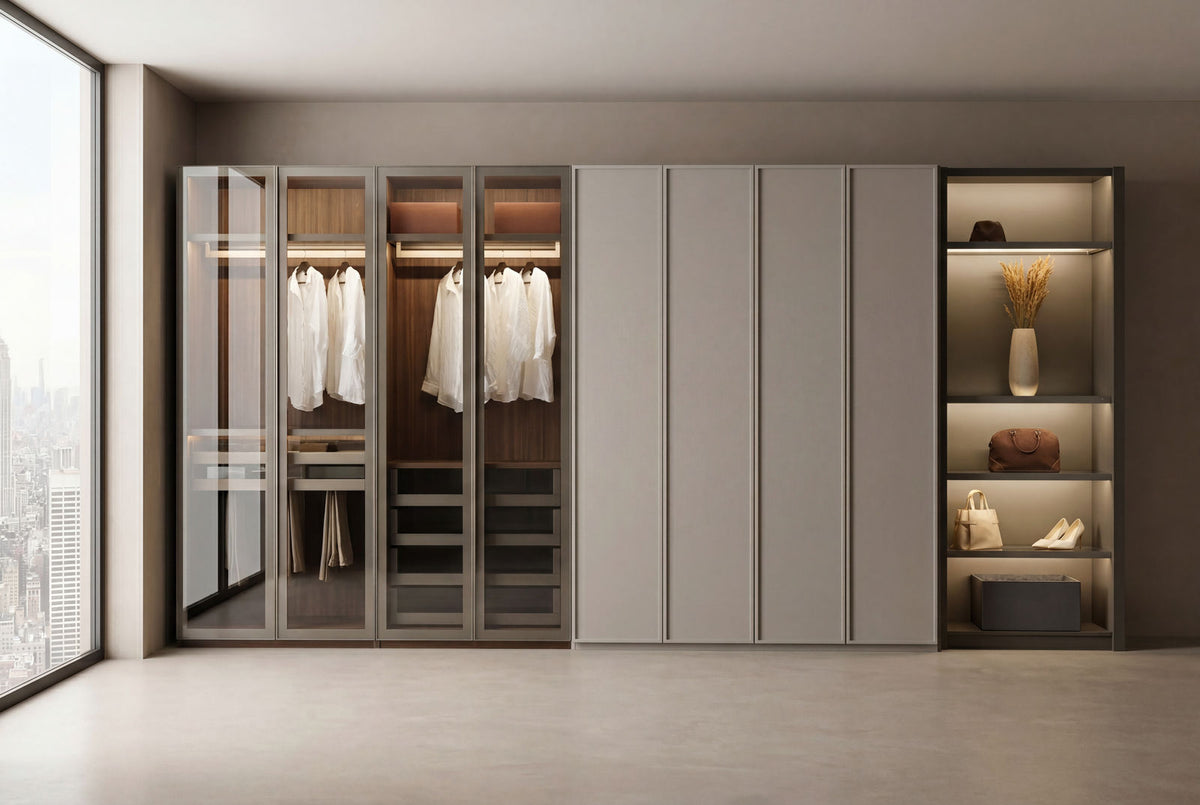
In a built-in closet, the front is designed with the cabinetry. Ferma closets have closed fronts in wood tones, fabric, leather, or lacquer. Vetrina glass closets use one glass type across the run, in extra clear, reflective, fluted, or mirrored. Spazio leaves the front open. Behind the front it’s the same closet, built by the inch.

We usually recommend mixing them: glass on the sections you want to see and solid on the sections that won’t stay tidy. Our custom built closets page shows finished fronts, and our guide to how to design a closet walks through the planning.
Let a Designer Size the Front With the Closet
Bring a rough measurement, or ask our in-house designers to help you take it. They’ll plan the front with the closet and show you the whole thing in a 3D rendering before anything is made. Book your design consultation, or find a LAZZONI showroom to see the fronts in person.
Frequently Asked Questions
What size are most closet doors?
A single hinged closet door is usually 24 to 36 inches wide and about 78 to 80 inches tall. Sliding sets are sold for openings of 48, 60, 72, and 96 inches.
Can you replace bifold doors with sliding doors?
Usually, yes. The two fit similar openings, so the swap tends to mean a new track and new panels rather than new framing.
Are mirrored closet doors outdated?
No, though heavy gold frames can date a room. Frameless or slim-frame mirror panels still give a bedroom a full-length mirror without using wall space, and one mirrored panel beside solid or fluted-glass ones looks deliberate.
Do closet doors need to match the other doors in the room?
No. Matching looks calm, and a feature front in glass or mirror works just as well. Pick one approach; a bit of both tends to look accidental.
How much do closet doors cost?
Installed, a bifold door usually runs about $100 to $300, a sliding set about $480 to $890, a barn door about $600 to $2,500, and a pocket door about $1,000 to $1,900, more if an existing wall has to be opened. Pivot doors vary most, from a few hundred dollars to $2,000 or more. For a whole closet, see our guide to how much a custom closet costs.
What are outward-opening closet doors called?
Swing or hinged doors, and a pair is a French door. Most closet doors open into the room so the rods and shelves inside stay clear.
What’s the difference between bifold and accordion doors?
A bifold folds in two wide panels per side; an accordion door folds in several narrow ones. The accordion suits an unusually wide or awkward opening, while a bifold looks more like a real door in a bedroom.
What is the cheapest closet door option?
A curtain on a rod costs the least, and you can hang one yourself in a few hours. Of the real doors, a bifold is the cheapest to buy and fit.
Does a walk-in closet need a door?
No. Many walk-ins stay open or use a pocket or sliding door. A door helps if you want to keep light or steam out. Our guide to walk-in closet sizing covers how much room the entry needs either way.
Share:
How Much Does a Custom Closet Cost? Price Guide 2026