





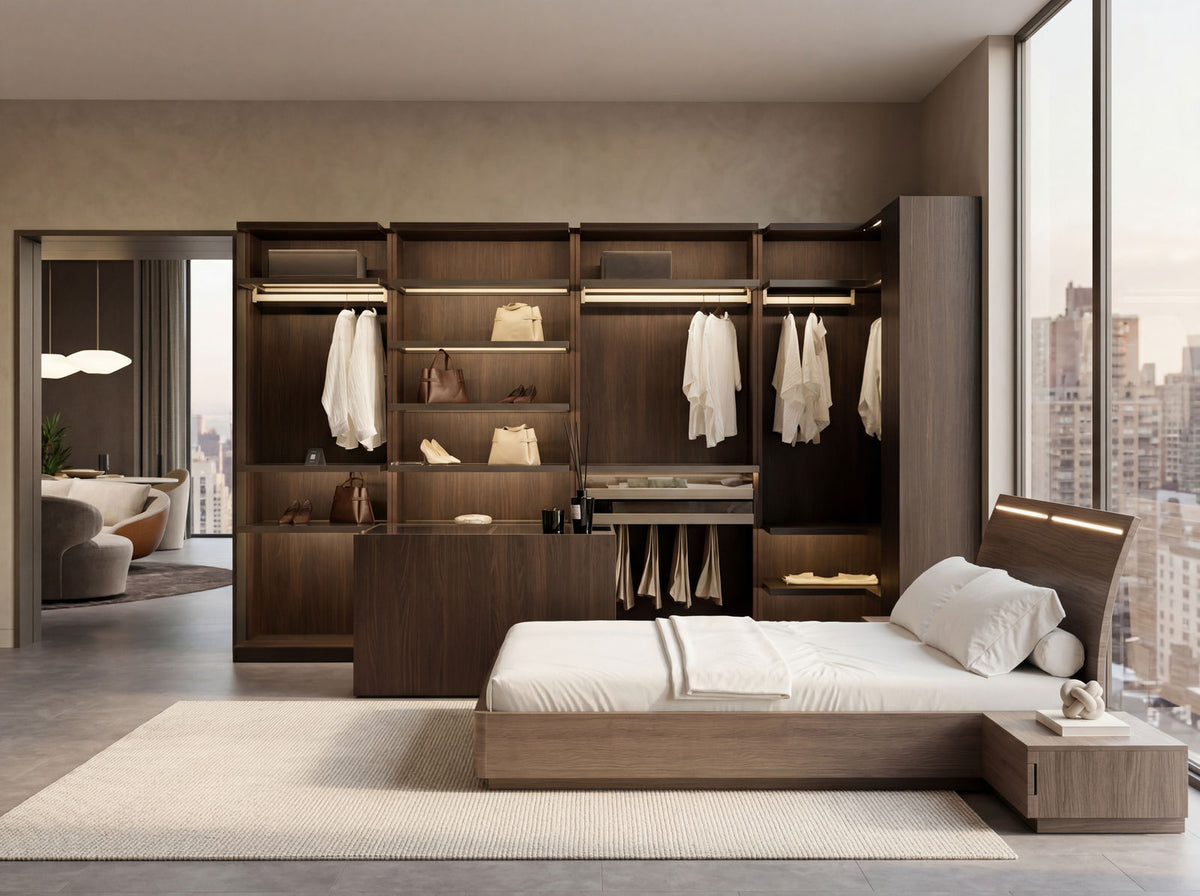
A custom closet costs less than most people expect, and it gives back more than they expect. It’s built around what you own, so every jacket has a place, every pair of shoes is in view, and getting dressed stops being a search.
This guide covers what custom closets cost by type, what you get at each budget, what moves the price, and how to keep it where you want it. At LAZZONI, our advice is simple: spend on the parts you touch every day, and keep the rest plain.
Key takeaways
How Much Does a Custom Closet Cost on Average?
Most custom closets cost about $1,000 to $10,000 installed, and a typical project lands in the low thousands. Where yours falls depends on how much cabinetry you need and what goes into it.
A handy way to estimate is by the foot. Installed closets usually run about $70 to $450 per linear foot of cabinetry, so an 8-foot reach-in at around $150 a foot comes to roughly $1,200. To use it for your own closet, measure the length of wall you’d like to fill rather than the floor area.
Custom Closet Cost Breakdown by Closet Type
|
Closet type |
Typical installed price |
|---|---|
|
Reach-in closet |
About $500 to $5,000 |
|
Walk-in closet |
About $1,000 to $10,000 |
|
Dressing room or bedroom conversion |
About $20,000 and up |
The low end of each row is shelves and hanging rods. The high end adds drawers, doors, lighting, and furniture-grade finishes.
Reach-In Closets
A custom reach-in closet typically costs $500 to $5,000 installed. It’s the standard bedroom closet you open from the room, and it’s where most people start. The price depends mostly on how much of the opening you fill with drawers and shelves rather than plain rods. Our guide to the types of closets explains how a reach-in differs from a built-in.
Walk-In Closets
A custom walk-in closet typically costs $1,000 to $10,000 installed. Walk-in closet cost grows with the number of walls you fit out: one wall costs about what a generous reach-in does, while three walls with drawers and a center island is a bigger project. If you’re still working out how much room you have, our guide to walk-in closet sizing covers the space a walk-in needs.

Dressing Rooms and Bedroom Conversions
A full dressing room usually starts around $20,000, because every wall gets cabinetry and the room often gains seating, a mirror, and lighting. It’s also the project that gains the most from design help. Our guide to turning a bedroom into a closet walks through the layout.
What You Get at Each Budget
|
Budget |
What it usually buys |
|---|---|
|
About $1,000 to $2,000 |
An 8-foot reach-in with shelves, rods, and a few drawers |
|
About $2,000 to $3,000 |
A basic walk-in, mostly hanging space and shelves |
|
About $5,000 to $7,000 |
A walk-in with more drawers, doors or glass fronts, and lighting |
|
About $20,000 and up |
A dressing room, with cabinetry on every wall and extras like an island or seating |
Every step up adds convenience you’ll use daily: more drawers mean no dresser in the bedroom, doors keep dust off, and lighting means you can see what you own.
Factors That Impact Custom Closet Pricing
Five things decide where your closet lands in those ranges.
Size and Layout
Price follows the length of cabinetry more than the size of the room, so the layout matters as much as the space. Corners and odd angles take a little more work, since they need extra panels or angled units to look finished.
Materials and Finishes
A plain laminate finish sits at the bottom of the range, and wood-look, lacquered, fabric, or leather fronts sit at the top. Our closets are made from engineered wood: recycled wood pressed into a dense, durable board, with no added formaldehyde and certified factory standards. You get that same board at every price point; the finish is what you choose.

Doors and Fronts
What closes the closet is one of the clearest price levers. Our closets are the same system behind the front, and each front has its own starting price, as listed on lazzoni.com.
|
LAZZONI closet |
Starting from |
|---|---|
|
Ferma solid closets (closed fronts) |
$1,475 |
|
Vetrina glass closets (glass fronts) |
$2,075 |
|
Spazio walk-in closets (open fronts) |
$2,225 |
|
Fully custom closets (sized to the inch, mix any material) |
$2,675 |
These are starting prices; the final figure depends on your room and your design. We usually suggest mixing fronts in one closet: glass on the sections you want to show off, solid on the ones that won’t always be tidy. It puts the money where it shows.
See your closet before you decide. A design consultation turns these starting prices into a 3D rendering and a price for your room. Book your design consultation.
Drawers, Lighting, and Accessories
Drawers and lighting are the upgrades people use most, and they’re also what moves a price fastest, because each one adds hardware and finishing. Then come the extras: pull-out hampers, jewelry trays, valet rods, and a center island, which is the biggest single add-on at about $1,000 to $2,500. Our guide to walk-in closet islands covers when a room can take one and when a bench does the same job in less space.
Installation and Design
How the closet is fitted affects the price too. When installation is priced as its own line, labor usually adds about $55 to $200 per linear foot. A wall-mounted system hangs off the floor and uses less material, so it costs less. A floor-to-ceiling system gives a true built-in look and costs a little more. Many closets mix both.
At LAZZONI, every closet starts with a design consultation: you share your measurements or ask us to help with them, review a 3D rendering, and then we handle production. Because each closet is custom made for your room, plan for a lead time of about 12 to 16 weeks on the East Coast and 16 to 20 weeks on the West Coast, as set out on our FAQ page.
Custom Closets vs Modular Closet Systems
A modular system is a good choice too, and we make both. Modular usually costs less to start, and it can move with you, which is why our modular closet systems include a Modular Renters closet. A built-in costs more up front because every panel is cut for your walls, and in return it uses the full height and width of the space, corners included. If you own your home, that’s usually the better long-term buy.
What It Costs to Live Without One
Skipping a custom closet has a cost too; it’s just spread out over time. Clothes that don’t fit end up in a dresser that takes floor space in the bedroom. Things you can’t see get bought twice. Jackets crease on overcrowded rods, shoes get scuffed in a pile on the floor, and mornings start with a search.
It shows up when you sell, too. As one real estate agent put it, a good closet is less about adding value than about what you lose by not having one.
Is a Custom Closet Worth the Cost?
For most people, yes. You get storage sized to your wardrobe, a finish that looks like part of the home, and hardware that still runs smoothly years in. Our closets carry a lifetime warranty on frames and a 6-year limited warranty on materials, mechanisms, and upholstery, excluding wear and tear, and the planning comes with the order, so you get a design service without designer prices. Our guide to whether custom closets are worth it goes deeper.
How to Keep Custom Closet Costs Down
A good designer will help you spend where it counts. These five habits keep a custom closet within budget without giving up what you’ll use most:
-
Leave some sections open. Doors and glass cost more than open shelving, so keep fronts for the areas that need them.
-
Trim drawers before you shrink the closet. A few well-placed drawers do more than a wall of them.
-
Hang where you can. Wall-mounted sections cost less than floor-to-ceiling ones, and they’re just as useful for hanging.
-
Start with the main wall. Fit out the wall you use most now and add an island or a second wall later.
-
Bring your measurements and a rough count of what you own. Hanging, folded, shoes, and long items: the clearer the brief, the closer the first price is to the final one.
How to Read a Custom Closet Quote Before You Sign
A good quote answers these questions without you having to ask:
-
Does it include measuring and design, or is that a separate fee?
-
Are the materials and finishes named?
-
How many drawers and doors are counted, and what hardware is on them?
-
Is lighting included, with the wiring?
-
What’s the lead time, and is it in writing?
-
What does the warranty cover, and for how long?
Get a Real Number for Your Closet
Ranges are a starting point; a design consultation gives you the figure for your room, with a 3D rendering to see it before anything is made. Book your design consultation, or find a LAZZONI showroom to see the closets in person.
Frequently Asked Questions
Is installation included in a custom closet quote?
It depends on the company, and it’s the line most worth checking when two quotes look far apart. A closet company that designs and builds the system usually fits it too, while a kit bought online leaves the fitting to you or a handyperson. Fitting matters for more than price: a closet that’s out of level or loose on the wall won’t feel custom for long.
What is the difference between a custom closet and a semi-custom closet system?
A semi-custom system uses standard-width modules picked from a catalog and trimmed to fit, and it works well in a standard reach-in with square corners. A custom closet is planned around your room, so it earns its price where the room isn’t standard: a sloped ceiling, a window on the closet wall, or an opening that falls between catalog widths.
How much does it cost to add lighting to a custom closet?
Adding LED shelf or rod lighting to an existing closet usually runs about $500 to $650 installed. In a built-in closet, lighting is planned into the cabinetry from the start, so it shows up as a line in the quote rather than a separate electrician’s visit.
Do custom closet companies charge for the design?
Some do. Design fees of a few hundred dollars are common, and many companies credit the fee back if you go ahead, so ask how it’s treated before you book. At LAZZONI, the design consultation and the 3D rendering are complimentary.
Does a bigger closet always cost more?
Not in proportion to its size. A large walk-in that’s mostly open hanging can cost less than a small reach-in packed with drawers, glass fronts, and lighting, because the price follows what goes inside the closet more than the floor it sits on.
Share:
Contemporary vs Modern Furniture: What’s the Difference?
7 Types of Closet Doors: Pros, Cons, and Space Needs