





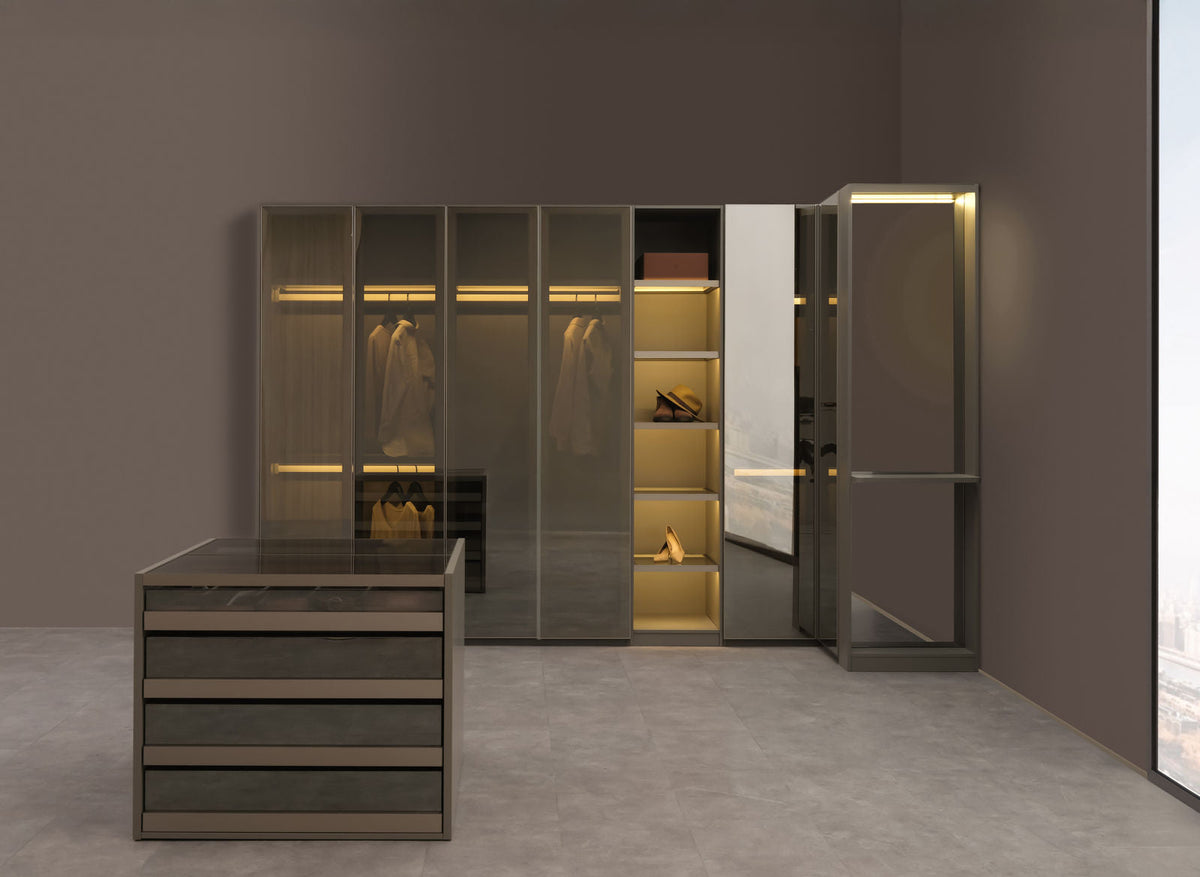
Most shoe collections end up in one of three places: a pile on the closet floor, boxes that rarely get opened, or tucked-away corners where favorite pairs get forgotten. The problem is that shoes often get whatever storage space is left over, even though heels, sneakers, and knee-high boots all need different solutions.
A better approach starts with the shoes themselves. At LAZZONI, our custom-made closets are designed down to the inch, allowing you to create shoe storage that fits your collection, from everyday sneakers to special-occasion heels and tall boots.
What’s the Best Way to Store Shoes in a Closet?
Keep shoes off the floor and organize them on shelves with enough space for each style. For most collections, adjustable flat shelves work best as the foundation, while drawers or closed compartments provide extra protection for delicate or seasonal footwear.
Arrange shoes in a single row so every pair stays visible and easy to reach. Giving footwear its own dedicated section also makes it easier to keep everything organized and find space for new additions.
Closet Shoe Storage Ideas, System by System
Most well-planned closets mix two or three of these.
1. Adjustable Flat Shelves
It’s the most versatile option and the right base for almost any collection. You can close the gap for flats and open it up for heels as your shoes change. If your collection shifts with the seasons, or two people share one shoe wall, adjustable beats fixed every time. The one downside: a shoe sitting flat shows its side rather than its shape.
2. Fixed Shelves and Cubbies
Cubbies give a clean, built-in look and keep each pair in its own spot, so nothing tips into its neighbor. They suit a collection that stays about the same, like a wall of similar sneakers. The catch is that a cubby sized for a loafer won’t take an ankle boot, so keep them to a small section. A freestanding closet shoe organizer with cubbies works the same way.
3. Angled Shoe Shelves
Angled shelves tilt each pair forward, with a low lip at the front to stop shoes sliding off, so you see the whole shoe at a glance. That’s why they show up in boutique-style closets, and our guide to walk-in closet ideas has more on face-forward display.
Save angled shelves for the pairs you want to show off, like heels, dress shoes, and favorite sneakers. Keep everyday pairs and boots flat: high-heeled, heavy shoes are the most likely to tip off a slope, and a tilted shoe also needs more height between shelves.
4. Pull-Out Shoe Racks
A pull-out rack is a low tray that slides toward you, bringing every pair into view. It’s a great fix wherever the back of a shelf is hard to see or reach: deep reach-in closets, the lowest section of a run, or a cabinet behind a door. Each tray has a set height, so keep pull-outs for low shoes.
5. Shoe Drawers
Drawers keep shoes away from dust and light, which makes them the best home for delicate pairs, occasion shoes, and anything seasonal. Flats, sandals, and slippers fit them well.
You can’t see what’s inside until you open them, and drawers are best decided at the design stage. Our custom closets are built with smart drawer configurations, so the drawer plan is part of the build from the start.
6. A Full-Height Boot Section
Tall boots get creased when they’re folded over to fit a shelf meant for shoes, and a crease in a leather shaft is hard to undo. A boot section, usually at the bottom of the run, lets them stand upright.
It’s worth it if you own several pairs of tall boots. For one or two pairs, a single shelf left open at boot height does the job. Either way, put boot shapers inside the shafts to keep them standing.
7. Glass-Front Display Sections
Glass fronts keep dust off the pairs you wear now and then while leaving them on view. Our Vetrina glass closets come in several finishes, including clear and fluted. We usually put the pairs you’re proud of behind glass and everyday pairs behind a Ferma solid closet front. Ferma, Spazio, and Vetrina are the same closet behind the door, so mixing them only changes the front.
8. Lit Shoe Shelves
A light strip along the front of each shelf gets rid of the shadow at the back, where dark shoes tend to disappear. Integrated lighting is part of our custom closets, so it’s built into the cabinetry rather than added later. It helps most on display shelves and in closets without a window.
How to Plan Your Shoe Storage
Three quick steps: count, check the spacing, and pick the mix.
Count Your Shoes First
Count your shoes by type: flats, sneakers, heels, ankle boots, and tall boots. Then measure your tallest pair and your longest pair, because those two decide the shelf spacing and depth. Our guide to designing a closet uses the same counting approach for the whole wardrobe.
How Much Space Each Type Needs
Shelf depth: 12 inches fits most shoes. Boots and larger sizes need a slightly deeper shelf, around 14–15 inches.
The space between shelves changes more from type to type. These are typical starting points, not fixed rules.
|
Shoe type |
Space between shelves |
Quick tip |
|---|---|---|
|
Flats, loafers, sandals |
About 12 in, less for very low pairs |
A good fit for drawers and pull-outs |
|
Sneakers |
About 12 in |
High-tops and chunky soles need a deeper shelf |
|
Heels |
15–18 in |
Measure your tallest heel, not your average one |
|
Ankle boots |
Set it to your tallest pair |
Buckles and zips add width |
|
Knee-high boots |
About 24 in |
Best in a full-height boot section |
For the room around the shoe wall, such as walkways and clearances, see our guide to walk-in closet sizing.

How Many Pairs of Shoes Fit in a Closet?
Plan on about 3–4 pairs per 3 feet of shelf. Smaller sizes and slim heels fit more, while boots and larger sizes fit fewer, so treat it as a rough guide rather than a promise.
Match the Storage to Your Collection
-
Mostly sneakers: adjustable flat shelves as the base, with a pull-out for the pairs you wear daily.
-
Mostly heels: shelves spaced for heel height, with a glass-front section for your favorites.
-
Mostly boots: a full-height boot section at the bottom, with flat shelves above for shoes.
-
A small mixed collection (under 20 pairs): one adjustable shelf section with a single boot-height gap at the bottom.
-
A large mixed collection (50+ pairs): a dedicated shoe wall with a display section, drawers for delicate pairs, and a boot section.
Not sure how your collection adds up? Our designers measure, plan the spacing, and show you a 3D rendering before anything is built. Book a design consultation.
How to Organize Shoes in a Walk-In Closet
Group shoes by type, then place each group by how often you wear it: daily pairs closest to the door, boots low, and favorites at eye level. Our guide to organizing a closet does the same for the whole wardrobe. Toes out or heels out, pick one and stick with it.

Daily-Wear Pairs
The three or four pairs you wear most belong on the easiest shelf to reach, between knee and shoulder height. Anywhere harder to reach, and they end up on the floor.
Sneakers
Give the sneakers you collect a separate section so they stay out of the everyday mix.
Heels
Keep each pair side by side rather than one tucked inside the other, since stacking scuffs the leather and can bend thin heels.
Boots
Boots go at the bottom of the run, where there’s the most height and the weight sits low. Give ankle boots their own shelf rather than squeezing them in with shoes, and keep tall boots upright.
Flats and Loafers
The lowest pairs make the best use of tight spaces. Put them in drawers, pull-outs, and the shorter gaps heels can’t use.
Small Closets and Underused Zones
In a small closet, shoes don't need a wall of their own. The space beneath short-hanging clothes can accommodate low shoe shelves, while corners and end panels are ideal for slim storage units. A built-in bench can also do double duty, with drawers underneath for extra footwear storage. Our guide to the walk-in closet island explores similar space-saving ideas for closets that don't have room for a traditional island.
For a setup that can adapt to future moves or changing needs, our modular closet systems include the Modular Renters closet, designed to move, expand, and reconfigure.
How to Keep Shoes in Good Condition in a Closet
Keep shoes somewhere dry and out of direct sun. Damp leads to mold, very dry air leaves leather brittle, and sunlight fades color, so a closet against a damp outside wall or beside a radiator is hard on shoes.
Cedar shoe trees also help: they draw moisture out of the lining and help shoes hold their shape, so put them in whenever the shoes come off.
Common Closet Shoe Storage Mistakes
-
One shelf spacing for everything. Flats waste the height, and heels get squashed.
-
Sealing shoes in plastic. Plastic bags and bins trap moisture against the leather.
-
Building the wall exactly full. If every shelf is taken on day one, the next pair goes straight to the floor.
Start With a Count, and Let Our Designers Plan the Rest
Bring your shoe count and your tallest pair to a design consultation. Share your measurements, or ask us to help take them, and our in-house designers will plan the spacing and show you a 3D rendering before anything is built. Book your design consultation, or find a LAZZONI showroom to see the closets in person.
Frequently Asked Questions
Can you store shoes on the closet floor?
You can, but it’s the worst spot in the closet for them. Shoes on the floor get kicked, stepped on, and dusty, and the pile gets in the way of cleaning. A bottom shelf raised a few inches keeps the same easy reach, lets air move around the pairs, and leaves the floor clear to vacuum.
How do you keep shoes fresh in a closet?
Let shoes air out overnight before they go back on the shelf, since a pair put away still damp is where most closet odor starts. Cedar shoe trees also absorb odor. Keep gym shoes in an open or ventilated section rather than behind a solid door.
How do you store suede and satin shoes in a closet?
Keep them out of the light and away from dust. Dyed materials fade faster than plain leather, so these pairs are better behind a solid front or in a drawer than on a lit display shelf. A cotton or flannel bag stops satin snagging and suede picking up dust.
How should you store shoes you only wear a few times a year?
Clean them before they go away, since dirt and salt get harder to remove the longer they sit. Slip each pair into a cloth bag, and give them the highest shelves or a closed drawer so they don’t take space from the pairs you wear every week. Check on them when the seasons change, both to air them out and to remember you own them.
How do you store shoe care supplies in a closet?
Give them a shallow drawer or a small closed compartment near the shoes, so polish, brushes, cloths, and spare laces sit close to the pairs they serve. Keep polish tins closed and away from fabrics, since a tipped tin stains whatever sits under it.
Share:
15 Living Room Decor Ideas for a Modern, Livable Home