





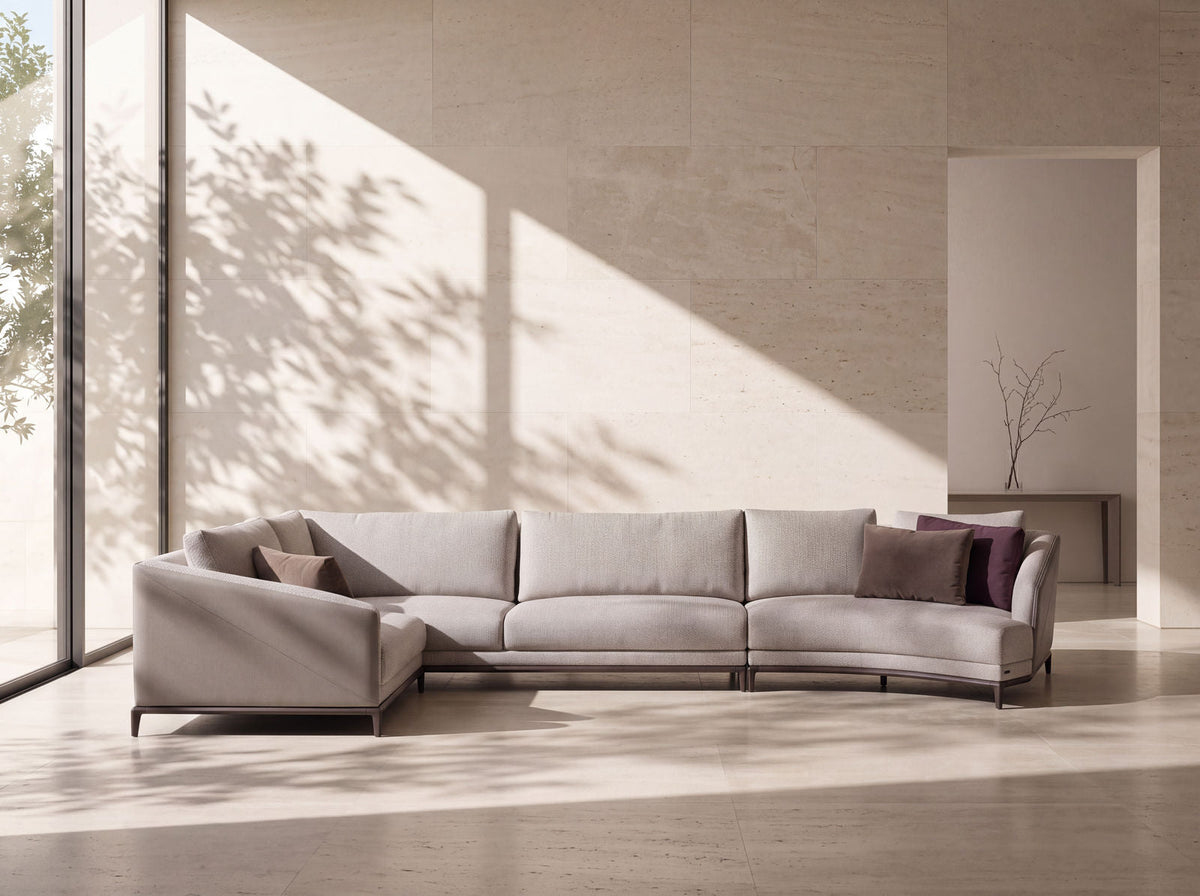
Every sofa looks well made in a photograph. Good lighting flatters a soft frame the same way it flatters a rigid one, and what decides whether a piece still looks right in eight years is exactly what a photograph cannot show.
Most of what matters is invisible: the frame, the suspension, the foam density, the fabric’s abrasion rating. This guide covers how to choose a sofa from the room outward, and what to ask for once you are standing in front of one.
How to Choose the Right Sofa for You
Start with how the sofa will be used, not with how it looks. Three questions do most of the work.
Who sits on it, and how? A household that reads upright wants a different seat depth from one that watches television lying down. If both happen daily, you are looking for an adjustable depth rather than a compromise between the two.
What else has to happen on it? Guests overnight points to a sleeper. Children and pets point to the upholstery before the silhouette. A room that doubles as an office changes where the sofa faces.
Is the layout settled? If you expect to move, or the room’s use is still changing, a modular piece keeps the decision open. If the corner is permanent, a fixed sofa gives you more seat for the money.
Only then does size come into it, and size is two measurements rather than one.
Measure the Room
Wall length, usable depth in front of it, and the walking space you need to keep. A room measuring 14 feet across may offer only 9 feet of usable width once a doorway swing and a radiator are accounted for.
As a proportion, a sofa should take up about two-thirds of the wall it sits against. Leave roughly 36 inches for the main route across the room and 14 to 18 inches between the sofa and the coffee table. These are designer rules of thumb rather than published standards, so adjust them to how your household actually moves.
Then mark it out. Run painter’s tape on the floor in the exact footprint, chaise included, and live with it for a day. That tells you more than any measurement on a page.
Measure the Delivery Path
A sofa that fits the room and not the door is still the wrong sofa. Measure the narrowest point on the route in: the entry door, the interior doorway, the hallway turn, the stairwell, and the elevator.
The measurement people miss is the diagonal. A sofa goes through a doorway tilted, not upright, so what matters is the diagonal across its height and depth. A piece 38 inches deep and 34 inches tall needs roughly 51 inches of clear diagonal, more than a typical 32-inch interior door provides. That is why the legs come off.
It is also the first practical argument for a modular system, which clears a tight stairwell one unit at a time.
If you are furnishing the whole room rather than replacing one piece, our guide to shopping for living room furniture covers the wider layout decisions.
How to Choose the Right Sofa Size
Once you know what the room allows, sizing is a question of proportion rather than of filling the space.
Against a 12-foot wall, the two-thirds proportion puts you around 8 feet. A 10-foot piece reads as furniture pushed into a space that cannot hold it. The rule bends for a room with a strong architectural feature or an unusually long sightline.
Standard Sofa Dimensions
There is no formal residential standard for sofa dimensions, so the ranges below are what the industry consistently builds to rather than a specification anyone is required to meet.
|
Measurement |
Typical range |
|---|---|
|
Loveseat width |
48 to 72 in |
|
Three-seat sofa width |
84 to 90 in |
|
Sectional total width |
94 to 156+ in |
|
Overall depth |
35 to 38 in |
|
Seat depth |
21 to 24 in |
|
Seat height |
15 to 20 in |
|
Back height |
30 to 36 in |
|
Arm height |
7 to 9 in |
Seat depth deserves the most attention, because it decides how the sofa is used rather than how it looks. Around 21 to 22 inches supports upright sitting. At 23 to 24 inches and beyond, the piece is built for lounging, and anyone sitting upright will find their back unsupported. If the household does both, an adjustable seat depth solves what a fixed dimension cannot.
Sofa, Sectional or Modular?
Three words, used interchangeably, describing different things. A sofa is one fixed frame. A sectional is a fixed L or U sold as one connected unit. A modular sofa is independent units that detach and recombine.
The last two are not opposites: sectional describes the shape, modular describes whether the pieces come apart, and a sofa can be both. Our sectional vs modular sofa comparison works through that choice properly, and the 10 best sofas for your living room covers every type with prices.
If the piece also has to sleep guests, that is a different set of trade-offs. Our guide to buying a sofa bed covers the mechanism, and the sleeper collection is the place to start.
Choosing a Sofa for a Small Living Room
Small rooms are usually treated as a footprint problem, and they are actually a visual weight problem. Two sofas with identical dimensions can make the same room feel completely different.

What makes a piece read as light is mostly what happens underneath it. A sofa raised on visible legs lets the floor run continuously beneath it, and a floor you can see reads as a larger floor. A piece that sits flush to the ground blocks that line and fills the room visually, whatever the tape measure says.
Depth matters more than width here. Trimming 3 inches of depth returns walkway where it is scarce, while the same 3 inches off the width usually costs a seat and returns nothing. A smaller-scale sofa or loveseat often seats as many people in less room than a sectional bought for the same purpose, and separate units let seating sit against two walls rather than cutting the room in half.
Why Sofa Quality Matters, and What It Actually Means
A sofa is a decision you live with for a decade or more, made in an afternoon. The difference between a piece that still sits well in a decade and one that sags in three is not visible in a showroom, and it is not reliably signaled by price.
“Quality” in a sofa is not one property. It is four, and they fail differently:
-
The frame decides whether the piece stays square.
-
The suspension is the layer that sags first.
-
The foam decides how long the cushion holds its shape.
-
The upholstery decides how it looks while all of that is happening.
Ours are made in Europe using certified European materials, which is where each of those four gets specified.
Each can be asked about directly, and each has an answer that is either specific or evasive. The rest of this section is what a specific answer sounds like.
The Frame
The frame is the part that decides whether the sofa is still square in fifteen years, and there is more than one legitimate way to build one.
Kiln-dried hardwood is the approach most guides name. Kiln drying matters because wood holds moisture, and a frame dried under controlled heat has already done its shrinking, so it does not warp or work its joints loose over the years. With hardwood, the joinery tells you more than the species: corner blocks and dowels hold under decades of load, staples and glue do not.
Engineered steel fails differently rather than worse. It does not respond to humidity at all, so warping is off the table, and the questions become the gauge of the steel, the welds, and whether the frame runs the full perimeter.
This guide deliberately does not rank them. What matters is that the maker can name which one you are buying and how it is joined. A seller who says “hardwood” but cannot say whether it was kiln dried has told you something useful.
Ours is metal. LAZZONI frames are formed rather than assembled: the steel is bent and formed to the profile of each piece and joined by oxygen welding, a torch process that melts the two pieces of steel into one another instead of clamping them together with brackets and fasteners. The result is a single continuous skeleton with no bolted joints to work loose, which is why the frame carries a lifetime warranty while the materials wrapped around it carry six years. The structure and the upholstery do not age on the same timetable, and the warranty is written to say so.
Suspension
Suspension is the layer between the frame and the cushion, and it is the most under-explained part of a sofa. It is also the part that sags first.
Eight-way hand-tied suspension uses coil springs tied by hand in eight directions. It is slow to build and it lets each part of the seat take weight on its own, and upholsterers will tell you a seat built this way is often still sound after about forty years of ordinary use. Sinuous springs, sometimes called no-sag or zig-zag springs, are lengths of shaped steel wire clipped across the frame, and the same rough expectation for those is about thirty years. Webbing, a woven strap platform, does not last as long as either.
Those figures come from the upholstery trade rather than from laboratory testing. Nobody has run a sofa for four decades in a laboratory to check. Use them to compare one system against another, not as a service life anyone is promising you.
Sinuous springs are not the lesser option, and it is worth being clear about that. A properly gauged sinuous system paired with high-resilience foam is a deliberate engineering decision, not a corner cut, and it is what sits under a great many well-built sofas. The Ikon and Milda seats, among others, use CrossWise Metal Webbing, a steel system developed by the LAZZONI design team to replace the elastic webbing found under much of the category. The question worth asking is never which system appears on the spec sheet. It is what gauge of wire it uses and how closely the rows are spaced.
Cushions and Foam
Sagging cushions are one of the most common complaints about a sofa, and the number behind it is foam density.
Density is a measure of how much material is packed into a given volume of foam, and it is what determines how long a cushion holds its shape. It is not the same thing as firmness, which is a separate measurement, and the two get confused constantly. A soft cushion can be dense and long-lived, and a firm one can be light and collapse inside three years. Density predicts lifespan; firmness predicts how it feels on day one.
Before comparing density figures, check which scale you are reading, because this is the second place in a sofa spec sheet where two markets measure the same property differently. North American specs quote pounds per cubic foot and conventionally put high-resilience foam, usually written HR foam, at roughly 2.5 to 2.9. European specs grade the same foam in kilograms per cubic meter, where HR35 and HR40 are standard grades. HR35 is about 2.2 pounds per cubic foot and HR40 is about 2.5, so a European grade can look low against a North American figure while describing a foam built to a recognized HR specification. Comparing the raw numbers across the two scales tells you very little.
It is also worth knowing that “high resilience” is defined by how the foam rebounds rather than by density alone. Density predicts how long a cushion holds its shape; resilience is what makes it push back rather than flatten. A foam can be dense and dead, which is why the label and the number are both worth asking for.
There is a structural answer underneath this too. LAZZONI’s HR foam is built with a deliberately uneven cell structure, where the small cells compress under light pressure to give the seat its initial softness and the larger cells engage as weight increases to provide the support.
Some LAZZONI seats go further again and sit on individually wrapped coils, the construction used in a good mattress: each spring is sleeved in its own fabric pocket, so it compresses where the weight actually is instead of dragging the springs beside it down with it. The Gola and the Merlin are built this way. It is an unusual thing to find in a sofa, and it is why those two feel closer to sitting on a mattress than on a cushion.

That is the kind of answer worth listening for: a mechanism, described specifically, rather than an adjective.
How to Choose the Right Sofa Material
Fabric is where most people start and where the most verifiable information exists, because upholstery durability is one of the few parts of a sofa that is actually tested to a published standard.

What Double Rubs Actually Mean
Upholstery abrasion is measured by rubbing a sample back and forth under pressure until it shows wear. One cycle is a double rub, and the count is how the industry compares durability.
The Association for Contract Textiles publishes the thresholds most of the industry works to: 15,000 double rubs for woven upholstery in a home, 30,000 for heavy-traffic public spaces, 50,000 for coated upholstery in the same use.
Now the part almost no guide mentions. ACT’s own guidance says results above 100,000 double rubs show no proven increase in lifespan, that the same fabric tested at different laboratories can vary by more than 60%, and that there is no valid conversion between the two main test methods. A very high number on a marketing page is not the proof it looks like. The figure separates adequate from inadequate, then stops being informative long before it stops being quoted.
Why a European Sofa’s Spec Sheet Reads Differently
If you compare an American and a European sofa on paper, the durability figures may not look comparable, because they are not measuring the same way.
North America tests with the Wyzenbeek method and reports double rubs. Europe tests with the Martindale method and reports cycles. The two produce different numbers for the same fabric, and because there is no valid conversion between them, a Martindale figure and a Wyzenbeek figure cannot be ranked against each other. When you are comparing a European-manufactured piece against a domestic one, check which test the number came from before drawing any conclusion from it.
Leather Grades
Leather is usually sold as vocabulary rather than explanation. Three terms are worth knowing, and one tends to go unmentioned.
Full-grain is the complete outer hide with its natural surface intact, scars and grain variation included. Those markings are the evidence it has not been sanded, and it wears into a patina rather than wearing out. Top-grain has had that outer surface lightly sanded and refinished, which makes it more uniform and more stain-resistant at the cost of some longevity. Aniline describes how the leather is dyed rather than how it is cut: dyed through, with no surface pigment, which is why it feels natural and marks easily.
The term that rarely appears in buying guides is corrected-grain, or pigmented, leather, where the surface is buffed and a pigment layer applied over it. It is the most uniform and the most stain-resistant, and the furthest from what most people picture when they hear leather. A legitimate choice; just worth knowing which one you are being shown.
Living with It
Ratings describe wear, not life. With dogs, children or a light-colored room, ask separately about cleanability and how the fabric handles a spill, because a fabric can be rated for heavy use and still show every mark. Performance weaves and tight textures hide wear far better than flat, pale, loosely woven fabric.
LAZZONI’s fabric and leather collection is where those trade-offs get made with a sample in hand rather than on a screen. Fabric and foam safety is covered separately in our note on non-flammable fabric and foam.
There is one more question worth asking about materials, and it is the easiest to check. Ask which certifications the piece actually holds, by name. A real answer names a standard: LAZZONI’s manufacturing certifications include EPA TSCA Title VI and European E1 for formaldehyde emissions, CARB2, FSC for responsibly sourced wood, and CE compliance. LAZZONI furniture is made in Europe using certified European materials, and those standards are what the certifications describe. An answer of “eco-friendly” names nothing and can be said by anyone.
How to Choose a Sofa Color
The most common color question is whether a sofa should be lighter or darker than the floor. It needs enough contrast to read as a distinct object rather than dissolving into it: on a pale oak floor, a mid-tone or darker sofa defines the seating area, while a pale sofa on a pale floor works only when a rug provides the separation the two tones are not. Match the room’s undertone rather than its color, since warm-toned grays read as slightly dirty in a cool-toned room.
Then consider wear. Very pale, flat, solid fabrics show every mark, and very dark ones show dust and pet hair just as clearly. The most forgiving choices sit between the extremes and carry some texture in the weave.
What the Price Actually Buys
Most guides say that quality costs more and stop there. It is more useful to know what separates one price tier from another, because then you can tell when a higher price is buying something and when it is buying a brand.
Four things account for most of the difference. The frame material and, more importantly, the joinery method. The suspension system and its gauge. The foam density, where the cost shows up slowest and the consequence shows up fastest. And labor, which is where a made-to-order piece diverges most sharply from volume production, because a piece cut and built to a specific configuration cannot be produced on the same terms as one built to a fixed pattern.
European made-to-order production sits inside that last factor: the piece does not exist when you order it, and the fabric is cut for your configuration rather than pulled from a warehouse.
The honest way to think about it is per year rather than per purchase. A sofa is commonly expected to serve somewhere between 7 and 15 years, and where a given piece lands in that range is usually decided by the four factors above rather than by the price on its own.
What a Sofa Warranty Should Tell You
A warranty is the one place a manufacturer commits to its own construction in writing, which makes it the most revealing document in the transaction. Almost no buying guide reads one properly.
Do not read the headline number, read the split. A serious warranty separates the frame from the mechanisms and springs, and separates both from materials such as foam and upholstery, because those three age at genuinely different rates. A long frame term alongside a shorter materials term is not a catch, it is the honest shape. A maker offering one term across all three either has a very short frame warranty or is not distinguishing between components that behave differently.
LAZZONI’s structure is a lifetime warranty on the frame, and a 6-year limited warranty covering materials, mechanisms and upholstery, excluding normal wear and tear. The lifetime term on the frame is a statement about the structure; the 6-year term on foam and fabric is a statement about what those materials honestly do. One detail worth knowing on any brand: LAZZONI’s materials coverage does not apply where the customer has self-assembled the piece.
Lead times belong in the same conversation, because made-to-order production is what the warranty is underwriting. LAZZONI publishes its factory and in-stock ranges, and they are worth asking about at the same time as the coverage.
The real test of any of this arrives years later, and it is not written on a warranty card. Some of the people walking into a LAZZONI showroom already own one: they bought a loveseat a decade ago, they are moving or adding a room, and they have come back to buy alongside it rather than to replace it. Nobody does that with a sofa that stopped looking right in year three.
The Five-Spec Check
Everything above reduces to five questions. If a seller answers all five specifically, you are looking at a piece someone can account for. If the answers stay at the level of adjectives, that is information too.
-
Frame. What material, and how is it joined? Kiln-dried hardwood with corner blocks and dowels, or steel at a stated gauge with the welds and perimeter accounted for.
-
Suspension. Which system, what gauge, and how closely spaced?
-
Foam. What density, stated as a number, and separately, what firmness?
-
Fabric. What abrasion rating, and from which test method, Wyzenbeek or Martindale?
-
Warranty. What is the split between frame, mechanisms and materials, and what voids it?
Take the five questions and the three measurements, the room, the walkway and the route in, and there is very little left that a photograph can hide from you.
Take the List With You
Sofa shopping feels endless because most of the information on offer describes how a sofa looks, while the decision turns on things you have to ask about.
You now have the questions. Measure at home first, then take the five specs to whoever is selling.
Bring them to us, if you like. LAZZONI designs and manufactures its own furniture in Europe, so the answers come from the people who built the piece rather than from a spec sheet passed along. You can arrange a design consultation or start on sofa by design, the main sofa page, where a configuration is specified piece by piece.
Frequently Asked Questions About Choosing a Sofa
How long should a good sofa last?
A well-built fabric sofa is commonly expected to last somewhere between 7 and 15 years, and pieces with a heavier frame and higher-density foam sit at the upper end of that. There is no industry study behind those figures, so treat them as a working expectation, not a specification. What shortens the range is almost always the same three things: low-density foam that compresses, a frame that loosens at the joints, and fabric asked to handle more wear than it was rated for.
Can you add sections to a modular sofa later?
Usually yes, and that is the practical advantage of a modular system over a fixed sectional. Two things govern whether it actually works years later: whether the collection is still in production, and whether your fabric is still available. Fabric is the more common obstacle, because dye lots shift over time and an exact match is not guaranteed. If you expect to expand the piece, ask about both before you buy rather than after.
Does assembling a sofa yourself affect the warranty?
It can, and this is worth checking on any brand before the box arrives. LAZZONI’s 6-year limited warranty on materials, mechanisms and upholstery is void where the customer has self-assembled the product. The reasoning is straightforward: a mechanism or a frame joint that was not assembled to spec fails differently, and the maker cannot stand behind work it did not do. Ask who is responsible for assembly and what it does to your coverage.
How long does a made-to-order sofa take to arrive?
LAZZONI factory orders run 12 to 16 weeks for East Coast deliveries and 16 to 20 weeks for the West Coast, with in-stock pieces at 2 to 6 weeks. Where you land inside that range depends largely on the upholstery, since a fabric that has to be brought in adds time before production even starts. If you are working to a fixed date, a move-in or an event, raise it at the design consultation rather than after ordering, because a known deadline can usually be planned around and a discovered one cannot.
What is the 2-2-1 rule for sofas?
It is a layout guideline rather than a sizing one: two main seats, two secondary seats such as armchairs, and one central anchor like a coffee table or ottoman, arranged so people can see and hear each other. It is design convention with no published standard behind it, and it is worth knowing that the same name is sometimes used for a cushion-styling formula, which is a different thing entirely. Treat it as a starting arrangement for a conversational room, not a rule.
How do you stop modular sofa sections from sliding apart?
Ask what holds them together before you buy, because this is a design question rather than a maintenance one. Modular systems connect in different ways, and some rely on weight and friction alone while others use a mechanical bracket or a locking connector between units. A system that connects mechanically will not need anti-slip pads under the legs later. If the answer is vague, that is your answer.
Share:
How to Turn a Bedroom Into a Walk-In Closet
Sectional vs Modular Sofa: What’s the Difference?