





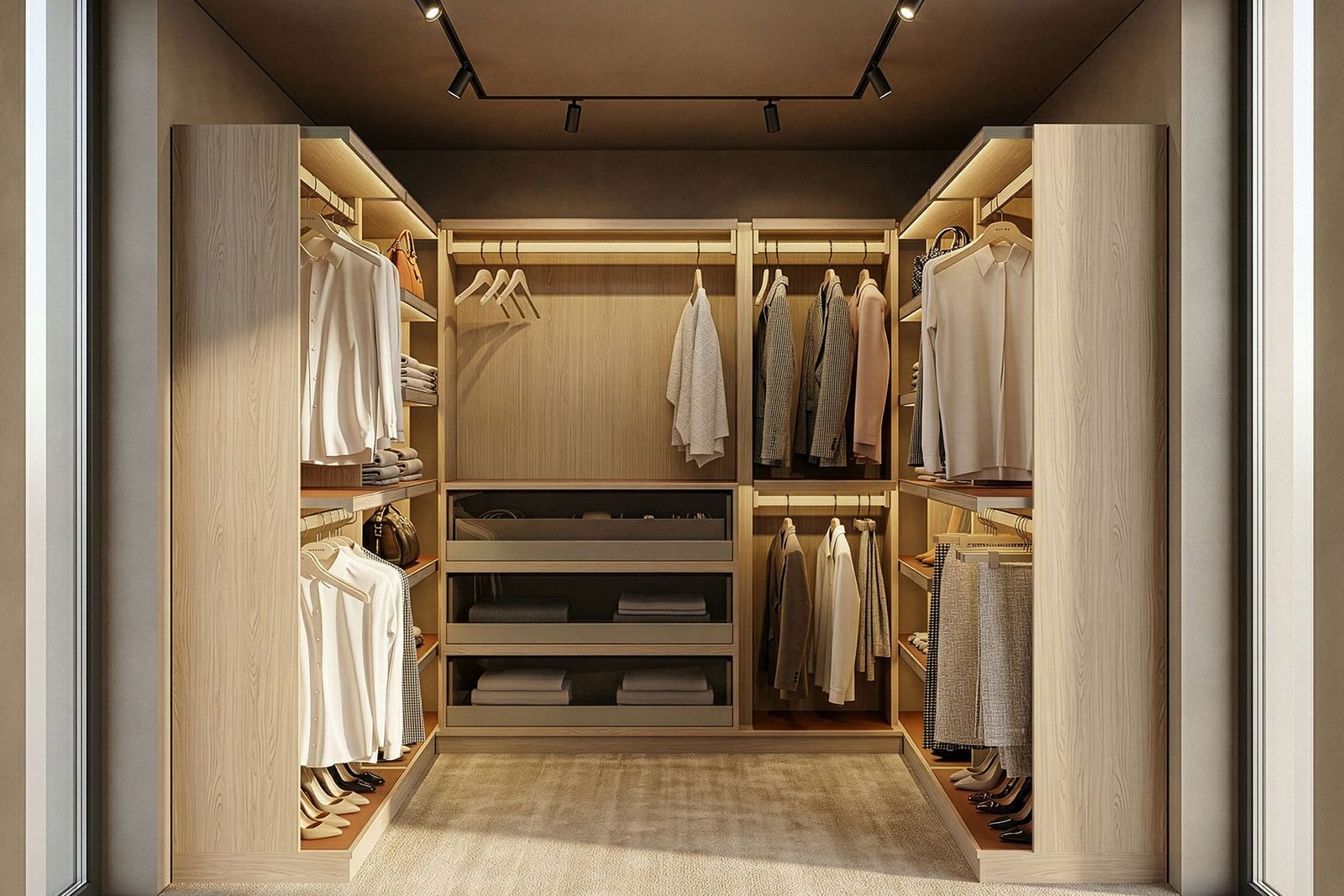
The question is rarely whether a closet can be built. It is whether the version drawn for your room is meaningfully better than the version that comes in standard widths, and whether that difference is one you will notice in ten years or forget in ten days.
It is a fair question, and the honest answer is that it depends almost entirely on how much of your room is standard. Very little of most rooms is.
That gap between the room you have and the widths a factory ships is the problem LAZZONI is built around. The company has been building in New York since 2009 and now runs 12 US locations, part of a 30+ showroom footprint spanning Canada, Europe, Turkey, and Asia, drawing on a woodworking history more than a century old. Custom closets, modular sofas, and full-home furniture are all made to order in Europe rather than assembled from stock sizes.
What Makes a Custom Closet Worth the Investment
A stock system solves storage. A custom closet solves the room.
That distinction sounds small until you stand in one. Standard units arrive in fixed widths, so a wall that measures 9 ft 4 in becomes an 8 ft run plus a gap. The gap does nothing, permanently, and every wall in the room contributes one. A closet drawn to the wall has no gaps to give away, which is where the extra capacity in a custom closet actually comes from.
The same logic governs everything else the room throws at you. None of these are unusual; all of them defeat a system built to standard dimensions, and all of them are ordinary work for a closet drawn from scratch:
-
Ceiling height. Stock systems stop at a standard height and leave the last 18 to 24 inches as dead air, usually disguised with a crown. In a room with high ceilings, that strip can be a quarter of the available volume. The dimensions that govern it are worth knowing before you accept any quote.
-
Corners. Where two runs meet, a standard system either stops short or creates a void behind the adjoining unit that nothing can reach. A drawn closet resolves it with an angled return, a carousel, or a pull-out, recovering several cubic feet.
-
The door. An inward swing claims an arc of floor and sterilizes the wall behind it. Fixed widths cannot be trimmed around it; a drawn plan simply is.
-
Slopes and returns. A sloped ceiling or a chimney breast ends a stock run early. Neither is an obstacle to units cut to the wall.
-
Windows. A window eats the best wall in most rooms. Low units beneath it recover the loss, but only if the run is planned around the sill height.
Tailored to How You Actually Dress
The stronger argument is not about the room at all. It is that a custom closet can be divided around one specific wardrobe.
Manufacturers set the proportions of a stock system from an average: so much hanging, so much shelving, a fixed drawer bank. Nobody owns an average wardrobe. Someone with forty pairs of shoes and six dresses needs a different closet from someone with a wall of tailoring and almost no folded clothing, and neither is served well by the same configuration.
Going custom means those proportions are yours. It also means the closet can be built around how you get dressed rather than only around what you store: the pieces you want visible on glass fronts, the ones you do not on solid; the everyday zone at eye level and the seasonal run above it; a vanity if you use one, and the floor left clear if you do not.
Style works the same way. Finish, hardware, glass type, and interior lining are specified rather than selected from a short list, which is what allows the closet to belong to the rest of the house instead of sitting in it as a visibly separate purchase. For a house where the interiors have been considered, that coherence is usually the point.
The detail that most often decides how a closet feels is which sections are visible. Glass fronts on the run holding tailoring and dresses turn the closet into something you look at; solid fronts on the sections that will never stay presentable keep the rest of it private. Specifying both across a single closet is the pattern to copy, not a compromise between two options, and it is only available when the fronts are chosen section by section rather than bought as a set.
Lighting follows the same rule. Integrated strips under shelves and above rails have to be planned with the frame, because the wiring routes through it. Added afterward, they are a lamp. Planned at the drawing stage, they are the difference between seeing what you own and guessing at it in the mornings.
What Separates One Custom Closet From Another
Most of this category looks identical in photographs, which is exactly the problem. Four things actually differ, and all four can be checked before you commit.
Whether the company makes what it sells. A large share of closet businesses are design and installation operations placing orders with a third-party manufacturer. LAZZONI manufactures its own in Europe. The practical consequence is who can change a specification and who can only pass the request along.
The standards behind the material. LAZZONI produces under ISO 9001:2015 and ISO 14001:2015, with FSC, CARB2, E1, CE, and EPA/TSCA VI compliance on materials, each listed with its auditing body on the certificates page. A certification that can be looked up is worth more than an adjective that cannot.
What the warranty commits to. A lifetime warranty on frames and a 6-year limited warranty on materials, mechanisms, and upholstery, excluding wear and tear, set out on the FAQ page. This is the clearest statement a manufacturer makes about how long it expects its own work to last.
Whether a designer draws your room first. Not a configurator working from module widths, but an in-house designer producing a 3D design of the actual space before anything is made. It is the step where the non-standard parts of a room get resolved. LAZZONI only brings the top 1% of designers from its European HQ to serve US clients.
There is a fifth that matters more in some houses than others: because the rest of the furniture is made by the same house, a closet can be specified alongside the bedroom, the media wall, and the living room. The full range sits in the custom closets and wardrobes collection.
The Resale Position, for What It Is Worth
This should not be the reason to build a closet, and anyone presenting it as an investment vehicle is selling something. It is worth knowing all the same, because it means the decision holds up on the way out as well as while you live with it.
Closet renovation recovers 83% of its cost at resale, the second-highest cost recovery of any remodeling project measured in the 2025 Remodeling Impact Report from the National Association of Realtors and the National Association of the Remodeling Industry. A new steel front door recovers 100%; a new fiberglass front door, 80%. A closet sits between them, ahead of the great majority of interior work.

Read it as a floor rather than a return. Most of what you spend on the inside of a house does not come back at that rate.
Built to Outlast the Room
The useful test is not how long a closet survives. It is whether you replace it because the house changed or because the closet failed.
Fitted, made-to-order units are built to the second standard, which is what the lifetime frame warranty is really communicating. It is also why manufacturing consistency matters more than it sounds: units carrying full wall height have to stay square and hold their alignment for decades, not seasons. The woodworking lineage behind that runs back to 1897 on Turkey’s Black Sea coast, documented on the history page.

What the closet itself should be is a separate set of decisions, and how to design a closet takes them in the order they have to be made, while the types of closets depend on which format suits which room.
Seeing It in Your Own Room
The gap between a good closet and the right one is almost always the fit: to the walls, to the wardrobe, and to the way the rest of the house is finished. That is not something a catalog can resolve.
The way to settle it for your own room is to have it drawn. Book a design consultation, hand over the measurements or ask for help taking them, and an in-house designer comes back with a 3D design before anything is made. If you want to arrive with a view already formed, the walk-in closet design ideas are a reasonable place to start.
Frequently Asked Questions
Are custom closets worth the money?
They are worth it when you want the closet to fit the room and the way you dress, rather than the other way round. A made-to-order closet is drawn to your walls and divided by what you actually own, so the proportions of hanging, drawers, and display are yours rather than a manufacturer’s average. That is the difference you live with daily, and it is the reason the decision is usually about design rather than storage volume.
Do custom closets increase home value?
In the US market, they perform unusually well. The 2025 Remodeling Impact Report puts closet renovation at 83% cost recovery, ahead of a kitchen remodel and behind very little else. It is a supporting fact, not the reason to build one: the daily experience of the room is what you are buying, and the resale position simply means the decision holds up.
What is the difference between a custom closet and a fitted wardrobe?
A fitted wardrobe is a set of units assembled in standard widths against a wall. A custom closet is drawn to the room: units sized to the exact wall, planned around the door swing, the ceiling height, and any slope or return, with the interior divided to your own garment counts. The visible difference is that a custom closet reads as architecture rather than as furniture placed in a room.
What should I look for when choosing a custom closet company?
Four things that can be verified rather than taken on trust: whether the company manufactures its own units or resells someone else’s, the manufacturing and material standards it works to, the warranty terms in writing, and whether a designer draws your specific room before anything is made. Ask for all four in the first conversation. The answers separate companies faster than a showroom visit does.
How long should a custom closet last?
A properly fitted closet should be replaced when the house changes, not when the closet fails. Warranty terms are the most reliable way to check what a manufacturer believes. LAZZONI closets carry a lifetime warranty on frames and a 6-year limited warranty on materials, mechanisms, and upholstery, excluding wear and tear.
Share:
15 Walk-In Closet Design Ideas for Every Space
How to Design a Closet: 8 Steps to Know