





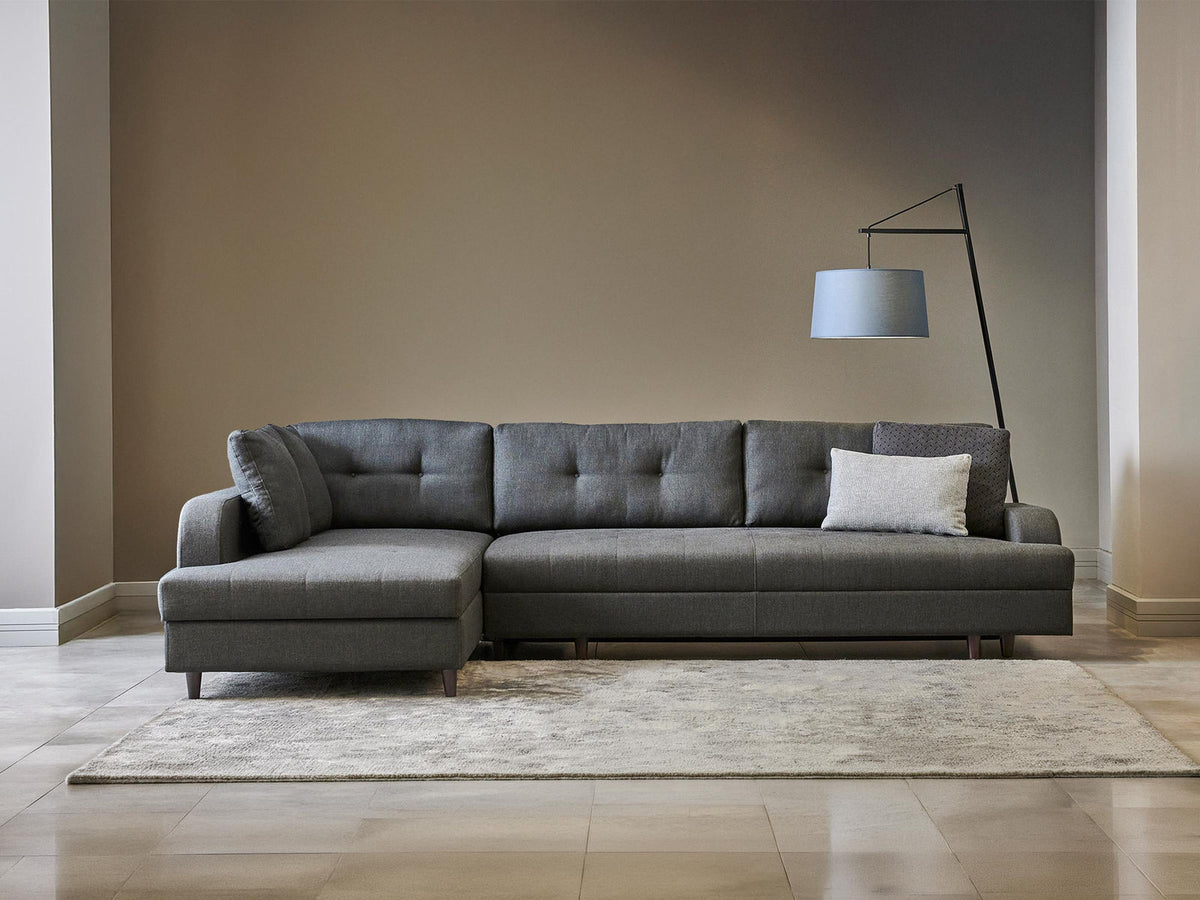
A sleeper sofa needs to work as both a sofa and a bed, but those two things don't always go hand in hand. A sofa should feel soft, deep, and comfortable to lounge on, while a bed needs to be flat, even, and supportive. The best sleeper sofas do both well, without sacrificing too much comfort in either setup.
LAZZONI is a European-manufactured furniture and custom closet brand with more than a century of woodworking expertise, established in New York in 2009 and now operating 12 US locations, plus a 30+ showroom footprint spanning Canada, Europe, Turkey, and Asia, offering modular sofas, custom-made closets, and full-home furniture. We build our sofa beds and sleepers as sofas first, with the bed designed into the frame from the start rather than added later.
What Is a Sleeper Sofa?
A sleeper sofa converts into a bed, and the interesting part is how that conversion actually happens.
There are two families, and telling them apart is the most useful thing you can learn as a buyer. Pull-out designs store a separate mattress and folding frame inside the seat base. Fold-out designs have no separate mattress: the cushions you sit on are the ones you sleep on, laid flat.
Neither is better in the abstract. They perform differently, and they cost different amounts of floor space to open. Knowing which family a piece belongs to predicts most of what it will be like to live with.
Sleeper Sofa vs Sofa Bed: What the Difference Actually Is
Most sellers use “sleeper sofa” for a piece with a separate hidden mattress that pulls out, and keep “sofa bed” or “futon” for a piece whose cushions fold flat. Plenty of sources do not draw that line at all, treating the two as names for one category and listing “sleeper sofa” alongside sofa bed, hide-a-bed and pull-out sofa as American variants of the same piece.
So, the practical answer is that “sleeper sofa” is largely the American term for what is more broadly called a sofa bed, and the narrower usage is a convention rather than a rule. Ask which mechanism a piece uses instead of relying on the label, and you will know what you are buying.
The Main Types of Sleeper Sofas
Six designs cover almost everything on the market. They differ in what moves and in what you end up lying on.
Pull-Out Sleeper
The classic. A folded metal frame holding a thin mattress sits inside the seat base. You remove the cushions, pull a strap at the front, and the frame unfolds in two or three hinged sections, with legs dropping into place as it extends.
This is the design behind the well-known complaint about feeling a bar in your back. The cause is simple: the frame has a crossbar, and a thin mattress doesn’t leave enough padding between you and it. Modern versions add foam to soften this, but the frame underneath is the same.
Best for: occasional guest use, where having a real separate mattress matters more than top-level comfort.
Click-Clack
The backrest pivots through a set of spring-loaded locking positions, from upright to reclined to flat. The name comes from the sound: it clicks as you move it and clacks as it locks.
There is no separate mattress. The padded seat and back you sit on become the surface you sleep on, which makes these slim, mechanically simple, and easy to open in a tight room. It also makes them firmer and more structured than a sleeper with a real mattress.
Best for: small apartments and short stays, which is why they dominate the folding sofa bed category for small spaces.
Futon
A wood or metal frame whose sections fold between a sofa position and a flat bed. Some are designed to open without being pulled away from the wall, which matters more than it sounds in a small room.
What sets a futon apart is that one flexible mattress does both jobs. You sit on it, and you sleep on it, so it takes everyday wear instead of staying tucked away inside the base.
Best for: budget-conscious buyers and rooms that switch between living room and bedroom often.
Daybed and Trundle
The outlier, because it does not convert at all. A daybed is a raised single frame that works as a lounger, with the mattress staying a mattress in both uses. A trundle is a second frame stored underneath that rolls out for another sleeper.
There are two kinds of trundles. A standard trundle sits roughly 6 to 8 inches off the floor once rolled out, which is fine for children but awkward for adults. A pop-up trundle rises on a lift mechanism to match the height of the main bed, creating two beds at the same level.
Best for: two sleepers at full mattress thickness, where nobody has to compromise.
Sectional Sleeper With Storage Chaise
A pop-up mechanism lifts the sleeping surface into place, and the chaise cushion lifts to reveal storage in the base for bedding and pillows.
This is the most space-efficient answer of the six, because it resolves the issue that undermines most sleeper sofas in practice: where the sheets and pillows are located when the bed is a sofa. If located in a closet across the room, it can create friction that quietly stops people from using the bed.
Best for: one piece doing seating, sleeping, and storage in the same spot.

Air-Mattress Sleeper
An inflatable mattress takes the place of the thin foam one inside a standard pull-out frame, and you set the firmness by adding or letting out air.
With no rigid crossbar right under you, the bar-in-your-back problem mostly goes away. The trade-offs are the ones inflatables always have: it needs inflating, and a slow leak turns into a soft, uncomfortable night.
Best for: upgrading an existing frame without replacing the sofa.
Are Sleeper Sofas Comfortable for Everyday Sleeping?
They can be, and it comes down to how they’re built. The sleepers people complain about and the ones people sleep on happily, are the same kind of product made to different standards, so it helps to know what to ask about.
Four things make most of the difference.
Mattress thickness. This is what separates a sleeper you can use every night from one meant for the odd weekend. A thinner mattress folds away more easily but leaves less padding between you and the frame. Advice on the right thickness for regular use varies, so ask what a specific model takes rather than relying on one number.
Mattress type. Memory foam molds to your body and eases pressure points but holds heat. Gel foam adds a cooling layer to the same feel. Innerspring, the kind with coils inside, has more bounce and breathes better.
What the mattress rests on. Most buyers never check this, and it may matter most. A mattress on a solid platform spreads your weight evenly. On a frame of bars and springs, you feel the frame through the mattress, and springs that loosen over time cause the sag and the dip you notice at the fold.
How the piece is built. The frame decides whether a sofa that felt right in the showroom still feels right years later. It’s the hardest thing to see, and the biggest difference between a well-made piece and one built to hit a price.
Get those four right and a sleeper sofa is a real bed that folds away. One thing often gets mixed up: research on the health effects of sleeping on a couch is about sleeping on a closed, unopened sofa, which is short and soft in the middle. That’s not the same as sleeping on a properly opened sleeper mattress.
If the room’s real problem is that someone needs a full bed most nights and the space cannot hold one, a Murphy bed is a different answer worth knowing about.
When to Choose a Sleeper Sofa, and When Not To
Choose one when the room’s main job is sitting, and its occasional job is sleeping. Guests a few times a year, a living room that hosts family at the holidays, a studio where you want the option without giving the whole room over to it. This is what the category is built for, and does it well.

Look closer at the specifications when the bed is the main job. If someone sleeps there most nights, the four things above matter most, and they’re worth going through with one of our designers before you choose.
Two practical checks before you commit. First, sizing: sleeper mattresses usually run narrower and shorter than household mattresses of the same name, so a sleeper queen is typically around 60 by 72 inches versus a household queen’s 60 by 80. Check the specifications rather than assuming your bedding will fit.
Second, clearance: published guidance on the clear floor needed in front ranges from about 30 to 42 inches; the number varies because sources measure different things. Rather than relying on a number, measure the fully opened depth of the model you want and tape that rectangle onto your floor. If you’d rather not measure yourself, our designers check the space with you during a Design Consultation.
What LAZZONI Offers
We build two sleeper types, and both start from the sofa rather than from the mechanism.
Biblio is a contemporary sleeper sofa that one person can set up in a few seconds. A storage area under the seat is sized for bedsheets and pillows, so the bedding lives with the bed. It’s a modular design, so it can be made to fit your room instead of the other way around, and it comes as a three-seater and as a corner chaise, in fabric or in two leathers.

Dante is built for small rooms. It comes in two sizes, a loveseat sofa bed and a single sofa bed, for narrow and awkward areas where a full sleeper will not fit.
Our frames are metal rather than wood because metal is lighter, lasts longer, and allows the modularity the modular sofa system depends on. The structures are humidity-resistant, finished in anti-rust paint, and oxygen-welded, and seating uses HR foam.
All our sofas, regular and sleeper, are made in Europe using certified European materials, and they carry a lifetime warranty on frames plus a 6-year limited warranty on materials, mechanisms, and upholstery, excluding wear and tear. Since a sleeper has moving parts, the mechanism coverage is the part to read closely. Full terms are on our FAQ page.
Because our sofas are modular and made by the inch, the conversion does not have to cost you the proportions of the room. You can see how that customization works across the sofa collection and in our guide to choosing the best sofa for your space.
Ask What the Mechanism Is Before You Ask What It Costs
When you shop, look past the label and ask what moves. Is there a separate mattress, or do the cushions fold flat? Does it rest on a platform or a bar frame? Where does the bedding go, and how easy is it to open?
Those answers tell you more than any product name, and each one is covered above. When you have chosen a type, our guide to buying a sofa bed covers what to check on a specific piece.
Modern sleeper sofas do not have to look like a compromise. The Biblio Three Seater Sofa Bed works as an everyday sofa and converts into a full bed when guests stay, and the Biblio Corner Chaise Sofa Bed adds the storage chaise. For a narrow room, the Dante Loveseat Sofa Bed and the Dante Single Sofa Bed are the compact choices.
Better yet, bring your room to us. Book your design consultation and our in-house designers will work out what your space can accommodate before you choose anything.
Frequently Asked Questions
How do you make a sleeper sofa more comfortable?
A mattress topper is the usual fix, as long as it still folds away when the bed closes. It can’t fix what’s underneath, though: if the frame has started to sag, a topper hides the problem rather than solving it, which is why what the mattress rests on matters more.
How often should you replace a sleeper sofa mattress?
There’s no set timeline, because it depends on use: a sleeper opened a dozen nights a year wears very differently from one used every week. Signs it’s time include a dip that’s still there after you close and reopen the bed, a fold line you can feel through the mattress, and springs that have started to loosen. Many sleeper mattresses can be replaced without replacing the sofa, so it’s worth asking about before you buy.
Can you use a sleeper sofa without opening it every night?
Yes, and most people do. A sleeper sofa is a sofa first, so it works as normal seating and only turns into a bed when you need one. That’s why how easily it opens matters: a sleeper that takes two people to wrestle open tends to stop being used.
Do sleeper sofas come in corner and sectional configurations?
Yes. A corner or chaise layout is often a better use of a small room than a straight sofa, for the storage reasons covered in the chaise section above. Our Biblio is made as both a three-seater and a corner chaise, and as a modular design, it can be built to fit your space.
Where do you store the bedding for a sleeper sofa?
Ideally, in the sofa itself. Designs with a storage compartment under the seat keep the sheets and pillows with the bed, which is why our Biblio includes one sized for exactly that. If storage is high on your list, mention it at your Design Consultation, and our designers will factor it in.
Share:
Los 15 mejores sofás para tu sala de estar
Almacenamiento inteligente para espacios pequeños: cómo aprovechar al máximo cada centímetro